
Planning an Electronic Fire Feature Near a Pool or Spa
An electronic fire feature can work beautifully near a pool or spa, but the project needs to be planned as a complete system. The burner, ignition controls, electrical supply, gas line, drainage, ventilation, equipment location, and surrounding water environment all affect the final installation.
The main question is not simply whether you should choose 12, 24, or 120 volts. The better question is: Which listed system can be installed correctly in this exact location while meeting its instructions and the locally adopted requirements?
Low-voltage controls may be part of the answer, but they do not make every location acceptable or remove the need for proper electrical protection. Water, wet surfaces, and electricity are a particularly unfriendly trio, so this is one backyard project where early planning beats creative improvisation every time. Wet skin and damp surfaces can significantly increase the danger of electrical shock.
Why Fire Features Near Water Need Extra Planning

Pool and spa area with a separate gas fire feature
A freestanding fire feature on a dry patio already requires careful attention to fuel supply, clearances, ventilation, drainage, and operating instructions.
Place that same feature near a swimming pool, spa, fountain, splash pad, or decorative water feature, and the environment becomes more complicated.
Possible sources of moisture include:
Pool splash-out
Spa overflow
Irrigation
Wind-driven rain
Fountain mist
Wet pool decks
Drainage backups
Cleaning hoses
Snow and ice
Condensation inside an enclosure
Electrical hazards around pools are not limited to equipment sitting directly beside the water. Pumps, filters, underwater lights, switches, receptacles, cords, and other powered equipment may all be part of the surrounding environment. The U.S. Consumer Product Safety Commission recommends professional inspection and correction of electrical hazards around pools, hot tubs, and spas.
That makes the fire feature one part of a larger electrical and construction plan—not a decorative appliance that gets dropped into whatever corner remains after the pool is finished.
Voltage Is Only One Piece of the System
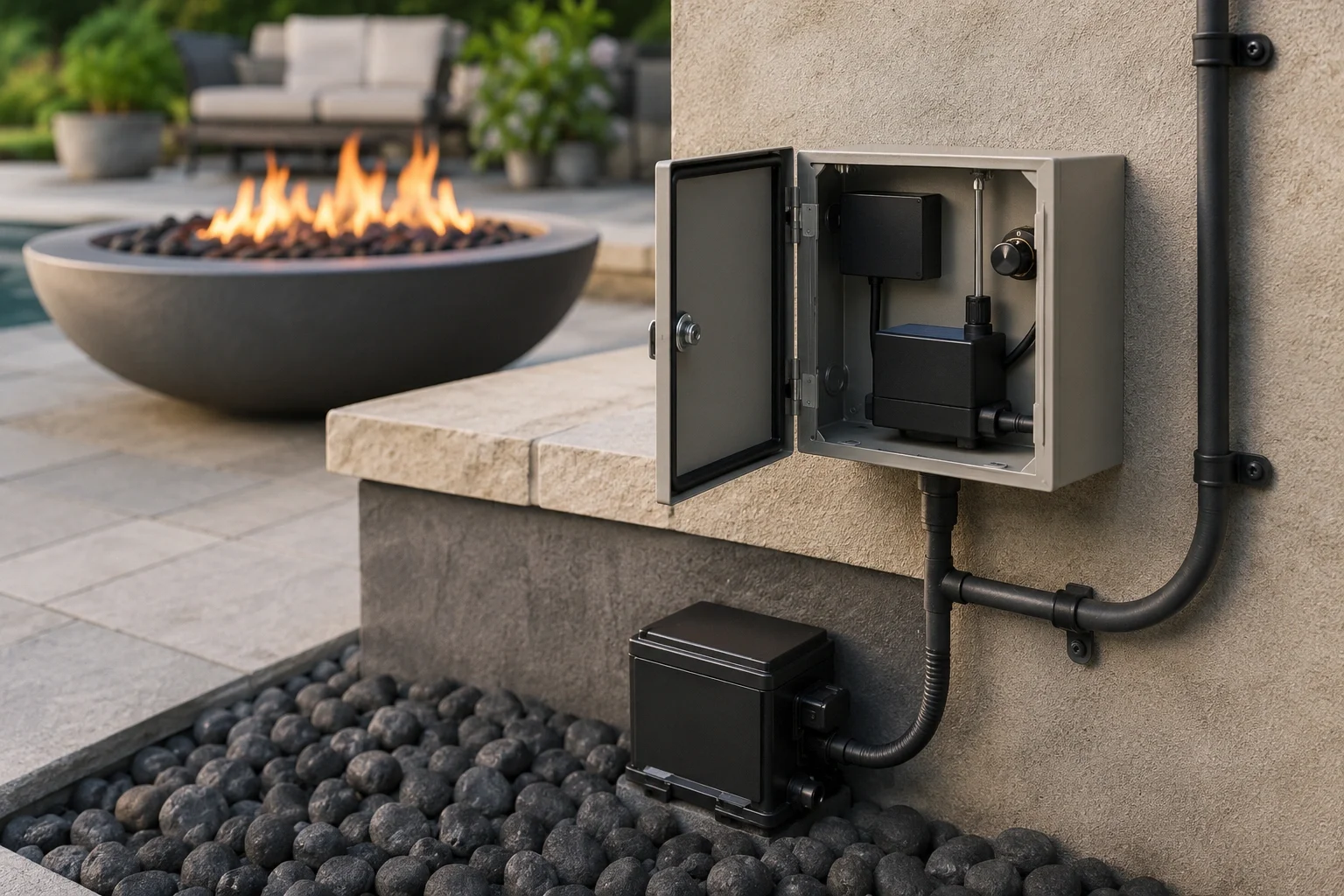
Protected controls for an electronic fire feature
Electronic ignition fire features may use 12-volt, 24-volt, or line-voltage power arrangements, depending on the product and control system.
Some installations use a 120-volt supply at a listed transformer or power supply. That equipment then provides lower-voltage power to ignition controls, flame-monitoring components, relays, or compatible gas controls.
Other systems may be designed around a different power arrangement.
The correct voltage must come from the fire-feature manufacturer’s instructions and equipment specifications. It should not be selected because one number sounds safer, stronger, or more convenient.
The complete system may include:
Transformer or power supply
Ignition control module
Gas valve
Flame-sensing components
Safety shutoff controls
Relays
Control switches
Automation equipment
Approved wiring and connections
Those pieces need to be compatible with one another. A 24-volt control module does not become a suitable replacement for a 12-volt component simply because both are called low voltage.
Does Low Voltage Make a Fire Feature Safe Near a Pool?
No—not by itself.
Lower-voltage control circuits can reduce the amount of electrical energy present at certain components. That can be useful in an outdoor installation, particularly where moisture exposure is a concern.
However, the term low voltage does not guarantee that:
The transformer is in an approved location
The wiring method is correct
Required GFCI protection is present
The equipment is suitable for outdoor use
Connections are protected from moisture
Bonding requirements have been addressed
The enclosure drains properly
Required clearances are maintained
The installation follows its listing
The equipment is permitted at the proposed distance from water
A low-voltage system installed incorrectly can still create hazards, damage equipment, and fail inspection.
I would treat voltage as one selection criterion among several. It matters, but it does not get to wear the entire safety cape.
The Role of GFCI Protection
A ground-fault circuit interrupter, or GFCI, is designed to interrupt power when it detects current traveling along an unintended path.
GFCI protection is particularly important in wet and outdoor environments. The CPSC strongly encourages GFCI protection for lights, receptacles, and switches around pools and spas, while the Electrical Safety Foundation International recommends GFCIs for outdoor electrical devices and keeping outdoor receptacles covered and dry.
A GFCI does not replace proper:
Wiring
Grounding
Bonding
Equipment placement
Weather protection
Maintenance
Manufacturer compliance
It adds another layer of protection.
The specific GFCI requirements for a fire-feature installation depend on the equipment, circuit, location, locally adopted electrical code, and manufacturer instructions. Those details should be confirmed by a licensed electrician familiar with pools, spas, and outdoor equipment.
Do not assume a receptacle has GFCI protection because it has a weather-resistant cover. The cover and the GFCI perform different jobs.
Grounding and Bonding Are Not the Same Thing
Grounding and bonding are often mentioned in the same conversation, but they serve different purposes.
Grounding is part of the electrical fault-protection system. Bonding connects conductive components to help reduce differences in electrical potential.
Around permanently installed pools and spas, equipotential bonding can be an important part of reducing voltage differences across conductive surfaces and components. NFPA research explains that bonding pool decks, nearby conductive objects, and water can help minimize hazardous potential differences.
Whether a particular metal fire-feature enclosure, gas component, nearby structure, or conductive surface must be included depends on the installation and the rules adopted by the local jurisdiction.
This is not something to resolve with a spare piece of wire and admirable confidence. The electrician and pool contractor should review the complete layout before construction begins.
Equipment Location Matters
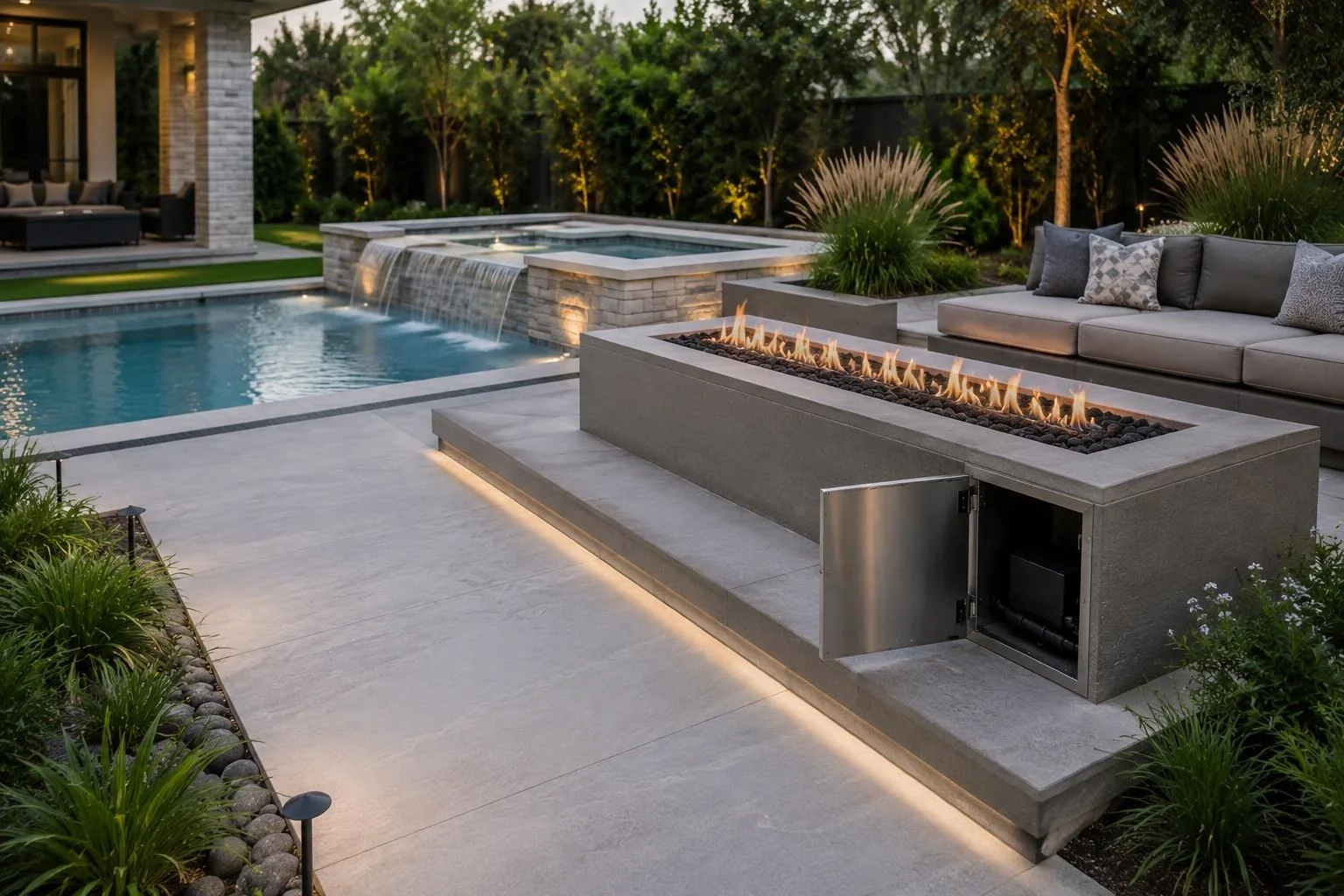
Protected controls for an electronic fire feature
Even when an electronic ignition system uses low-voltage controls, the transformer, power supply, control box, wiring, and service access still need appropriate locations.
The installation plan should account for:
Distance from the pool or spa
Normal splash zones
Pool overflow
Fountain spray and mist
Patio drainage
Irrigation patterns
Conduit routes
Gas-line routing
Access for future service
Burner ventilation
Enclosure drainage
Combustible clearances
Seating and walking areas
A control box should not be installed where normal pool use repeatedly soaks it.
At the same time, electrical and gas components should not be buried behind permanent stonework where they cannot be inspected, tested, or serviced as required.
The goal is not to hide every mechanical component until the patio looks magically self-operating. The goal is to protect the equipment while preserving proper access.
Use Equipment Approved for the Installation
Outdoor fire-feature components should be suitable for the environment in which they will operate.
Before ordering, review the product documentation for:
Required input voltage
Transformer specifications
Approved installation locations
Outdoor or wet-location suitability
Maximum wiring distances
Required wire type and size
Gas-valve compatibility
Drainage requirements
Ventilation requirements
Temperature limitations
Service clearances
Automation compatibility
Replacement-part requirements
Do not mix ignition controls, transformers, gas valves, and flame-sensing components unless the manufacturer confirms that the combination is approved.
A generic outdoor enclosure also does not automatically make indoor-rated controls suitable for an outdoor fire feature. The box, connections, wiring method, heat exposure, ventilation, and complete system listing still matter.
Plan for Drainage Without Blocking Ventilation
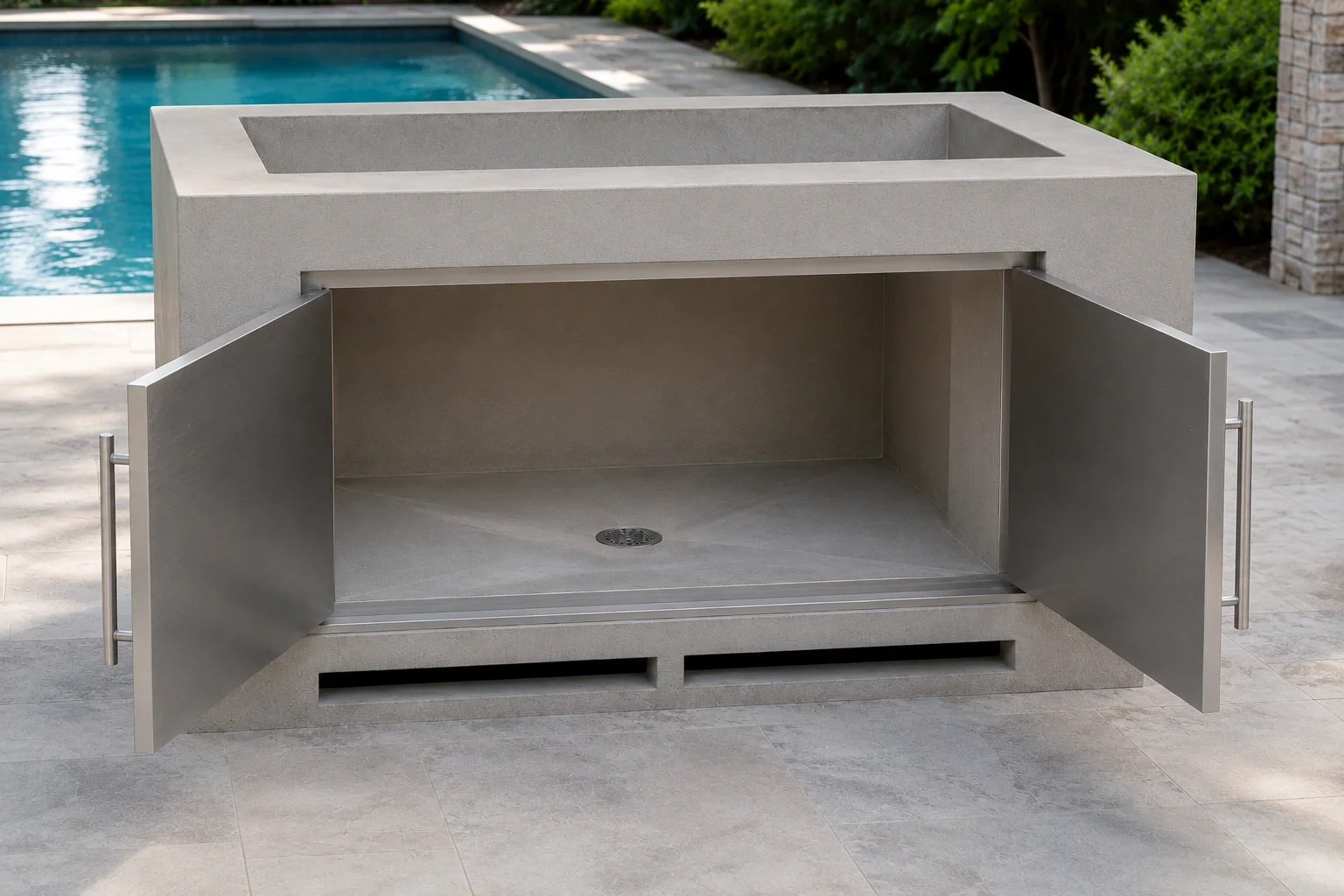
Drainage and ventilation in a fire-feature enclosure
Fire-feature enclosures may need openings for drainage, airflow, cooling, combustion air, or the safe dispersal of unburned gas.
Those openings should not be blocked in an attempt to keep water out.
Instead, the surrounding design should help prevent water from collecting inside the enclosure. Patio slope, drainage pathways, burner-pan design, enclosure construction, and the manufacturer’s instructions all need to work together.
Pay attention to water that may arrive from unexpected directions.
A fountain can create fine mist that travels in the wind. A raised spa can overflow. Irrigation heads can gradually rotate out of position. Pool maintenance may involve hoses and spraying that were nowhere to be seen on the landscape rendering.
Pretty drawings tend to show water behaving itself. Real water has other hobbies.
Decide How the Fire Feature Will Be Controlled
Electronic ignition systems can offer several control options, but compatibility should be confirmed before equipment is purchased.
Depending on the listed system, possible controls may include:
Wall switch
Key switch
Remote control
Timer
Pool automation
Home-automation interface
Emergency shutoff
Commercial control system
Not every ignition system works with every automation platform.
The control method also affects wiring, equipment placement, transformer requirements, and service access. Decide how the fire feature will be operated before the electrician and hardscape contractor finalize their work.
The controls should be placed where they can be used safely without requiring someone to lean over the burner, step through landscaping, or reach across the pool edge.
Bring the Trades Together Early
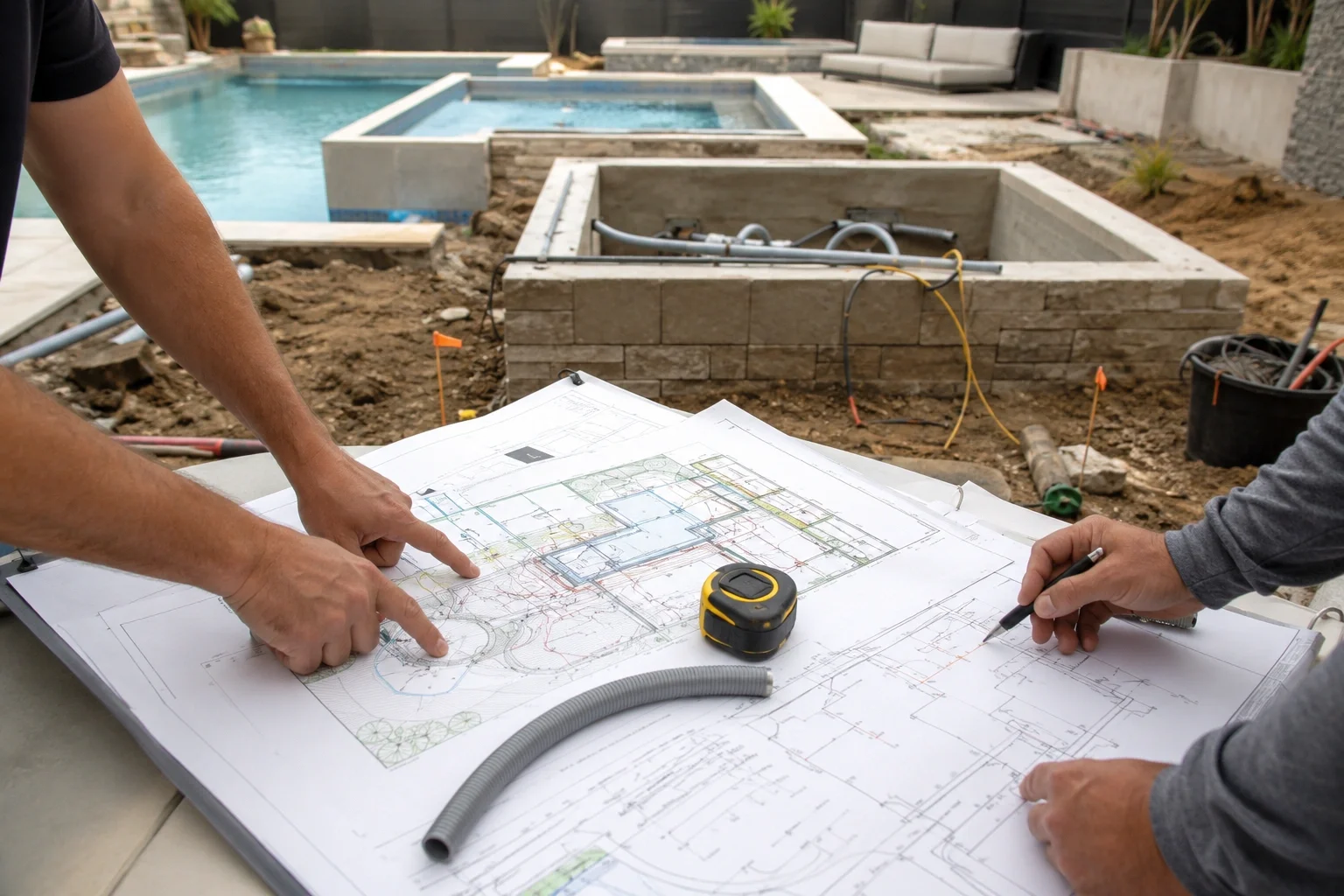
Contractors planning a poolside fire feature
A poolside fire feature may involve several professionals:
Pool contractor
Licensed electrician
Licensed gas professional
Mason or hardscape contractor
Landscape designer
Fire-feature supplier
General contractor
Local inspection authority
Each person controls a different piece of the project.
The electrician needs to know where the transformer, controls, conduit, and protective devices will go. The gas installer needs the appliance requirements and final burner location. The mason needs ventilation, drainage, and access details. The pool contractor needs to understand bonding, equipment areas, and water exposure.
Problems begin when each trade receives a different drawing—or when the fire feature arrives after the patio has already been poured.
A short planning meeting before construction can prevent:
Conflicting conduit and gas routes
Inaccessible controls
Insufficient drainage
Incorrect power supplies
Missing service panels
Automation incompatibility
Last-minute changes to finished decking
Moving a line on a plan is painless. Cutting a trench through brand-new stone is where the project starts using stronger language.
Questions to Answer Before Ordering
Use this checklist before selecting an electronic ignition fire feature:
Where will the feature be installed?
How close is the proposed location to water?
Is the area exposed to splash, mist, irrigation, or overflow?
Which ignition systems are approved for that environment?
What input voltage does the complete system require?
Is a transformer or separate power supply needed?
Where may that equipment be installed?
What wiring method does the manufacturer require?
What GFCI protection applies to the circuit and equipment?
What grounding or bonding requirements apply?
How will the enclosure drain?
What ventilation openings are required?
How will technicians access the controls later?
Which control or automation method will be used?
Who is responsible for permits and inspections?
Do not place the order until the professionals involved can answer the questions that affect fit, power, gas supply, and code compliance.
Common Mistakes to Avoid
Selecting the Fire Feature Too Late
Choosing the burner after the pool deck is finished can leave no suitable path for power, controls, drainage, or gas.
Select the general system early, even when the final decorative finish comes later.
Treating Low Voltage as a Universal Solution
Low voltage may be useful, but it does not erase location, wiring, GFCI, bonding, listing, or installation requirements.
Hiding Components Permanently
Controls need protection and appropriate service access. Do not seal transformers, valves, or ignition modules behind masonry unless the approved design specifically allows it.
Ignoring Water Beyond the Pool Edge
Splashing is only one source of moisture. Consider overflow, fountains, irrigation, storms, drainage, cleaning, and seasonal weather.
Mixing Unapproved Components
A transformer, valve, or ignition module with the correct-looking voltage may still be incompatible with the rest of the system.
Assuming Every Jurisdiction Uses the Same Rules
NFPA describes the National Electrical Code as a benchmark for safe electrical design, installation, and inspection, but the code edition and local amendments enforced for a particular project can vary by jurisdiction.
Confirm the rules locally rather than relying on a requirement copied from a different project.
Nadia’s Final Thoughts
A successful fire feature near a pool or spa starts with coordination, not decoration.
Choose a listed electronic ignition system that suits the actual environment. Confirm the required voltage, transformer location, GFCI protection, bonding considerations, wiring method, drainage, ventilation, gas supply, and control method before construction begins.
Low voltage can be part of a well-designed system, but it is not permission to skip the rest of the planning.
Fire and water can look wonderful together. Electricity is simply the part of the relationship that insists everyone read the instructions first.
Frequently Asked Questions
Is a 12-volt fire feature automatically safe near a pool?
No. Lower-voltage controls may reduce electrical energy at certain components, but the complete installation still depends on proper equipment selection, placement, wiring, GFCI protection, bonding, weather protection, and local requirements.
Is 24 volts better than 12 volts for electronic ignition?
Not automatically. Use the voltage required by the listed ignition system and confirm that the transformer, wiring, control module, gas valve, and other components are compatible.
Can a low-voltage fire feature receive power from a 120-volt circuit?
Some systems use a 120-volt supply connected to a listed transformer or power supply, which then delivers lower-voltage power to the controls. Follow the specific system instructions.
Does a poolside fire feature need GFCI protection?
GFCI protection may be required depending on the circuit, equipment, location, adopted code, and manufacturer instructions. Have the project reviewed by a licensed electrician.
Can the transformer be installed inside the fire-feature enclosure?
Only when the listed equipment and manufacturer instructions allow that location. Heat, water exposure, ventilation, drainage, clearances, and service access must all be considered.
Who should install an electronic fire feature near a pool?
The project may require a licensed electrician, qualified gas professional, pool contractor, and fire-feature installer. Licensing, permit, and inspection requirements vary by location.
